Brisbane Container Transport: Port Pickups, Site Deliveries and Empty Returns
Most people arrive at this page with one of three problems. A container has landed at the Port of Brisbane and needs to get to a warehouse. A container is sitting empty at a site and has to go back before the shipping line starts charging for it. Or a container is needed on a block of land, a building site or a business yard, and there is no crane or forklift to put it down. Brisbane container transport covers all three, and the best way to get the right result is to work out which one you have before you ring anyone.
This page walks through the job types, the trucks, the site checks and the details we need from you. If you would rather skip to the end, send us the job details or call 0407 977 529.
Start with the job type
1. Collecting an import from the wharf
Your goods have arrived by sea and are in a container at a Port of Brisbane terminal. You (or your freight forwarder or customs broker) have a release, and now you need a booked truck to collect it and take it to your door. Timing is driven by the terminal's booking windows and by the free days on the container. For the detail behind this, read our guide to container transport from the Port of Brisbane and our page on wharf cartage in Brisbane.
2. Delivering an export
An empty container is delivered to your site, you pack it, and it goes back to the terminal before the vessel's receival cut-off. The order of events matters: the shipping line or your forwarder gives you the empty's pickup details, the container comes to you, you pack and seal it, and then the loaded box has to make its window at the port. Late packing is the usual cause of trouble, so build in margin.
3. Returning an empty
Once an import container is unpacked, it goes back to a container park nominated by the shipping line. Parks have their own hours and rules. Getting this wrong means a wasted trip or extra days of line charges. Our empty container transport page and the guide to empty container pickup and dehire cover the details.
4. Moving a container between sites
Yard to yard, depot to site, or one job site to another. These moves are not tied to a vessel or a terminal window, so timing is flexible, but the site access questions below matter more.
5. Getting a container onto your property
Storage containers for a business, builders' site sheds, a rural block, or a project that needs a secure box on the ground. This is where the sideloader comes in, and where the site check decides everything. See container delivery in Brisbane.
Which truck moves which container
There are two ways a container gets off a truck. Either something on the ground lifts it off, or the truck lifts it off itself. That one question decides the equipment.
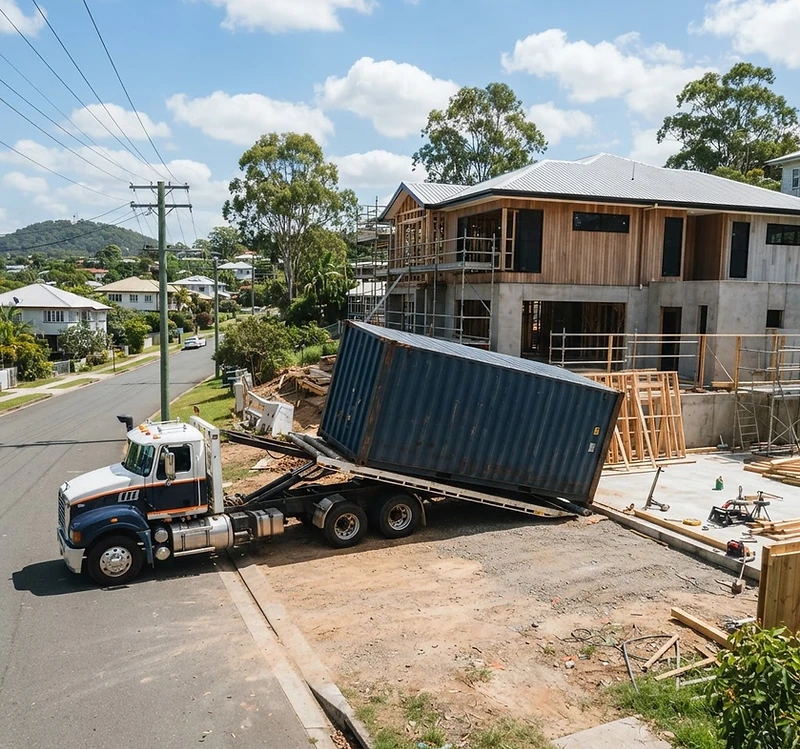
Sideloader (side lifter or swing lifter). Two cranes mounted on the trailer lift the container from the side and set it down at ground level. Nothing else is needed on site. This is the right choice where there is no forklift, dock or reach stacker, or where the container has to be placed on the ground in a yard, on a block or beside a building. Sideloaders need clear space beside the delivery position so the trailer can work, so access matters. Read more on our sideloader page.
Skeletal trailer (skel). A flat frame with locking points for the container. It is not self-loading. It backs to a dock, or is unloaded by your forklift or reach stacker, or is dropped in a yard where other equipment will handle it. For most warehouse deliveries and most port work, this is the standard. If your site has dock access and the equipment to handle the box, a skel is simple and quick.
Specialised trailers. Flat racks, open tops and out-of-gauge cargo can need different trailers, permits or escorts. Tell us early if your container is not a standard box.
The container sizes we are asked about
- 20ft general purpose: the everyday container for imports and site storage. Type code on the door is usually 22G1.
- 40ft general purpose: for larger consignments. Needs a longer trailer and more turning space. Type code usually 42G1.
- 40ft high cube: the same footprint as a 40ft but taller. Check overhead clearances at the delivery site, and along the route if there are low structures. Type code usually 45G1.
- 10ft and other short containers: popular for site storage. Check what your site can handle.
- Reefers, open tops, flat racks: talk to us before booking. Reefers need power at the destination if they are staying on. Open tops and flat racks need suitable equipment to load or unload.
The stencilled code on the container door tells us most of what we need, and the container number tells the terminal or park what it is. If you have both, send both. For size trade-offs, see our 20ft vs 40ft guide.
A five-minute site check before you book
Sites are where most avoidable problems come from. Before you ring, answer these:
- How wide is the gate or driveway, and is there a bend or a kerb to negotiate? A truck with a trailer is much longer than a ute.
- What is overhead? Power lines, trees, awnings and verandahs all affect a container that is being lifted and swung.
- Is the ground firm and level enough? Soft, sloping or unsealed ground is a real risk after rain. A loaded truck can bog, and a container placed on soft ground can settle.
- Where exactly does the container go, and is there clear space beside that spot? A sideloader works from the side of the trailer.
- What will unload it? A forklift, a dock, a reach stacker, or nothing (a sideloader can put it down and you unpack by hand)?
- Who will be there, and when? Someone who can direct the driver saves time and reduces mistakes.
- Are there local restrictions? Some streets, estates and council areas limit truck size or hours. Check with the landowner or your council if you are unsure.
If you can text a photo of the entrance and the placement spot, we can give a much better answer, much sooner.
What we need to quote and book
- Container number, size and type (or the door code)
- Shipping line, and for port jobs, the release or delivery order details
- Pickup and delivery addresses, with the access notes above
- Loaded or empty, and if loaded, the approximate weight
- Whether the receiver has a dock, forklift or reach stacker
- When it has to be there, and whether there is a free-time or cut-off deadline
- A contact on site, with a mobile number
We reply with a plan and a quote. We do not publish rates on this website because the answer depends on the container, the run and the site.
What can go wrong, and how we plan for it
The release slips. A container can be held for customs, biosecurity or shipping line reasons. Nothing can be booked until it is clear. We ask for updates from your forwarder or broker and re-plan when it moves.
The terminal window is missed. Terminal vehicle booking systems run on set windows. Miss yours and the pickup may need to be rebooked. We plan arrival with margin, and ask you not to hold us at the gate with last-minute changes.
The site turns out to be tighter than described. This is the most common issue on sideloader deliveries. It is cheaper to ask for photos early than to turn a truck around.
The empty goes to the wrong place. Return locations are set by the shipping line. Send us the return details and we deliver to that park.
Weather. Heavy rain can make unsealed sites unsafe. If we think a delivery position is at risk, we will say so rather than push ahead.
Areas we move containers
We move containers across Brisbane and South East Queensland. For local road, precinct and access detail see:
- Port of Brisbane, Hemmant and Acacia Ridge
- Brisbane Northside and Brisbane Southside
- Logan, Ipswich, Gold Coast and Sunshine Coast
If you want to see how the port-side operating side works, from terminals and slots to empties and depots, see our overview of Brisbane container haulage.
Frequently asked questions
That depends on the job. For an import it usually covers booking the pickup window, collecting the container from the terminal and delivering it to your site. For an export it covers delivering the empty and returning the packed container to the terminal. For an empty return it covers taking the unpacked container to the park the shipping line nominates.
Get a free container transport quote
Send us the container details and we will reply with a plan and a quote.