Sideloader Container Transport Brisbane — Side Loader & Swing Lifter Services
Self-loading side lifters place 20ft and 40ft containers at ground level on your site — no crane, no forklift, ideal for tight access and residential delivery across Brisbane.
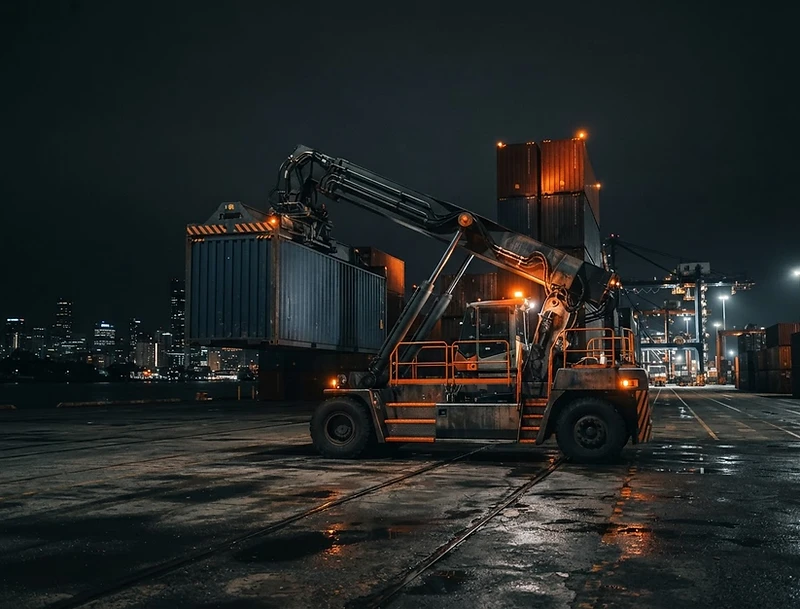
A sideloader — also known as a swing lifter or side lifter — is the most versatile truck in container transport. Fitted with hydraulic lifting arms, it loads and unloads shipping containers from the side, placing them at ground level on your site without needing a crane, forklift or loading dock. If you've got a container going somewhere a standard truck can't easily reach, a sideloader is almost always the answer.
We run sideloaders across Brisbane and South East Queensland for residential delivery, commercial sites and direct Port of Brisbane pickup. If you need a container placed where access is tight, get a quote and we'll confirm the right equipment for your site.
What is a sideloader and how does it work?
A sideloader is a prime mover paired with a trailer fitted with two hydraulic cranes (lifting arms) mounted at each end. To load, the truck parks alongside the container, the arms extend out and attach to the container's corner castings, and the container is lifted up and onto the trailer. To unload, the reverse: the truck parks beside the placement spot, the arms lift the container off the trailer and lower it to the ground.
The whole operation is self-contained on the truck. There's no need for a separate crane to be on site, no forklift, and no loading dock. That's what makes sideloaders so useful — they turn almost any firm, reasonably level piece of ground into a container placement site.
Benefits of sideloader transport
Self-loading
Lifts the container on and off itself — no crane, forklift or loading dock required on site.
Ground-level placement
Drops the container flat on the ground exactly where you want it, ready to use.
Tight access
Gets into driveways, yards and narrow sites where a tilt tray or semi can't reach.
20ft & 40ft
Handles both standard sizes, plus high cube, on the same truck — one call, any container.
Ground-level container placement
The defining feature of a sideloader is that it places the container at ground level — not on a trailer, not on stands, but flat on the ground ready to use. That matters because most containers are meant to sit on the ground on their corner castings, and a lot of sites don't have the infrastructure to take a container off a trailer. With a sideloader, the truck does the lifting, and your container lands exactly where you want it.
Site access requirements
Sideloaders are access specialists, but they still need a few things to work safely. Before dispatch we'll run through your site with you:
- Gate and access width — typically 3m+ clear for the truck and trailer to enter
- Side access to the placement spot — the truck parks alongside where the container will land
- Overhead clearance — no low power lines, branches or eaves over the placement area (remember the container is lifted above the trailer)
- Firm, level ground — the truck plus a laden container is heavy; soft or steep ground won't hold
- Room to manoeuvre — enough space for the truck to enter, position and exit
If you're unsure whether a sideloader can get into your site, send us a couple of photos of the access and placement area and we'll confirm before dispatch.
20ft and 40ft sideloader capacity
Our sideloaders handle both 20ft and 40ft containers, including high cube (HC) units, on the same truck. That flexibility means one call covers whatever size you're moving — you don't need a different truck for a 40ft. For 40ft high cube, the extra height is accounted for in the lift and clearance planning. For container transport of either size, the sideloader is often the cleanest option.
Swing lifter operations
"Swing lifter" is simply another name for a sideloader — the arms swing out to lift and swing in to stow for travel. The terms are used interchangeably in the industry. Whatever you call it, the capability is the same: self-loading, self-unloading, ground-level placement of 20ft and 40ft containers from a single truck.
When to choose a sideloader vs a tilt tray
Both trucks move containers, but they suit different sites. Here's the quick decision guide:
- Choose a sideloader when access is tight, the site is residential or built-up, there's no run-off space, or you need the container placed precisely at ground level
- Choose a tilt tray when the site is open with clear run-off space in front of where the container will land, common on building sites and rural blocks
When in doubt, tell us about your site and we'll specify the right truck. Getting this wrong is the most common cause of a failed delivery — and it's entirely avoidable with a two-minute conversation. For a broader guide on which truck moves which container, see our main transport page.
Residential sideloader delivery
Sideloaders are the standard for residential container delivery across Brisbane. They place a 20ft or 40ft container in a driveway, side yard or backyard at ground level with minimal impact — no crane swinging over your house, no forklift tearing up the lawn. We deliver to homes across Brisbane, the Redlands, Bayside, Logan, Ipswich and beyond.
Commercial sideloader transport
For commercial sites — construction, mining, events, remote facilities — sideloaders place site offices, storage containers and project cargo where infrastructure is limited. If there's no loading dock and no crane, the sideloader is the tool. We handle single placements and multi-container site setups. Where the container is one you already own — collected from a yard, or moved from one address to another — see shipping container transport in Brisbane for how those moves are run.
Port of Brisbane sideloader pickup
Our sideloaders work the Port of Brisbane terminals, so we can collect a 20ft or 40ft container directly from DP World, VICT or Patrick and deliver it straight to your site in a single self-loading move — wharf to door, no double-handling. That's the most efficient way to get an import container from the port to a residential or tight-access site.
Sideloader site preparation
A little preparation makes the difference between a smooth sideloader delivery and a difficult one. Before the truck arrives, it's worth doing a quick check of your site:
- Clear the access — move cars, bins, trailers and anything else away from the gate and the path to the placement spot
- Check the ground — if it's been wet, soft or recently filled, the truck plus a laden container may not hold; lay boards or pick a firmer spot if needed
- Mark the placement spot — chalk, tape or a marker so the driver knows exactly where the container should land
- Confirm overhead clearance — recheck for power lines, branches and eaves over the lift path, not just the resting spot
- Have someone on site — the driver will need to confirm placement, so someone should be there to direct
If you're unsure about any of this, send us photos when you book and we'll talk you through it. Most access problems are solvable with a bit of planning — it's the unplanned ones that cause failed deliveries.
Sideloader transport booking
Sideloader transport is priced like any container move — by size, distance, movement type and timing — with the self-loading capability built in. Because the sideloader loads and unloads itself, there's no separate crane or forklift hire to add, which often makes it the most economical option for tight-access and residential sites. For a quote, use our quote builder — tell us the size, the service and the two locations, and we'll come back with a plan and a quote.
Need a container placed where access is tight? Get a sideloader quote and we'll confirm the right equipment for your site.
Sideloader Container Transport Brisbane questions, answered
A sideloader (also called a swing lifter or side lifter) is a truck fitted with hydraulic lifting arms that pick up a shipping container from the side and carry it on a trailer. It loads and unloads the container by itself — no separate crane, forklift or loading dock needed — and places it at ground level on your site.
Get a free container transport quote
Send us the container details and we will reply with a plan and a quote.