Shipping Container Transport in Brisbane
A container you have bought, or one you already own, still has to be lifted, carried and set down. This page covers depot collections, moves between addresses, the trucks that do the lifting, and what the site needs before one arrives.
If you have bought a shipping container, or you already own one sitting on a site, this page is about moving it. That is a different job from collecting an import off a wharf: there is no shipping line and no terminal booking, because the container is yours. What you need is a truck that can lift it, a driver who can get into both ends of the move, and a clear idea of where the box should sit when it lands. Send us the details or call 0407 977 529.
When the container is already yours
Most moves on this page fall into three shapes. A container you have just bought, sitting in a depot or yard, that needs to come to your address. A container you have had for a while — storage in a yard, on a building site or on a farm — that has to move somewhere else. Or a shuffle: the same box going to a new spot on the same property. In each case the container is your property rather than a shipping line's, so the paperwork is simpler and the timing is yours. What does not change is the physical problem: a steel box weighing tonnes has to be lifted onto a truck and set down again somewhere with room for it.
Collecting a container you have just bought
When you buy from a depot or yard, the container is usually sitting on the ground in a row or a stack, so something has to lift it. Ask the yard what they can do. Many have a reach stacker or a forklift with the right attachment and will load the box for you, which is the simplest arrangement. If they cannot lift it, that is not a problem: a sideloader picks a container up off the ground and carries it away, so a box can be collected from a yard with no loading gear at all. Tell us the size and whether it is empty — a new container almost always is, but say so rather than leave it to be assumed.
Moving a storage or site container to another address
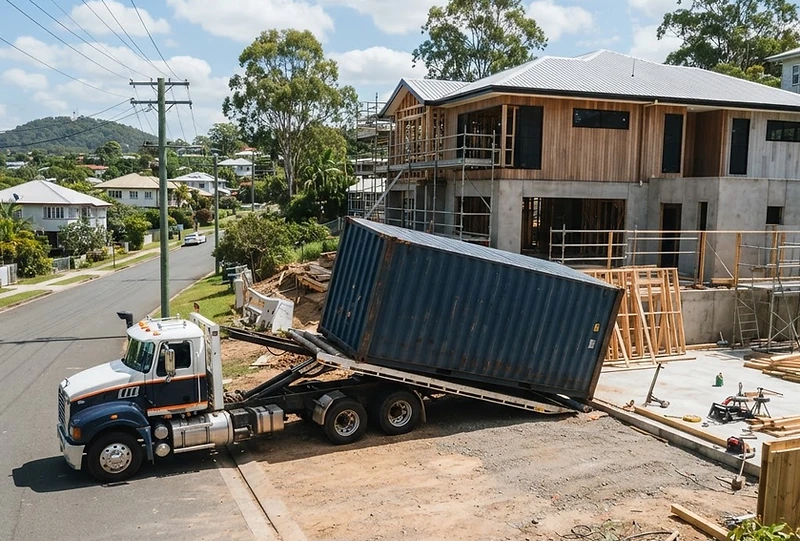
A container that has been in use is on the ground, and the truck has to lift it from where it stands. That is the difference from a depot collection: no dock, no yard equipment, just the box on a patch of ground. Two things decide how the move runs. The first is whether the container is empty. The second is whether the ground around it lets a truck get alongside — a box against a fence, under a tree, boxed in by pallets or sitting on soft ground can leave no room to position. A photo taken a few steps back answers that better than a description. Where it is going matters just as much, because the truck has to place it there, not just arrive.
Sideloader, tilt tray or skel: which truck
Three ways a container gets on and off a truck, and the difference is what does the lifting.
A sideloader carries two cranes on the trailer. It lifts the container from the side and sets it down at ground level, so it can collect from a yard with no gear and place on a site with no gear. That suits a box that starts on the ground and ends on the ground, which is most private moves.
A tilt tray tips and slides the container off the back. It needs clear run-off space in front of where the box lands, which suits an open block or a cleared building site, but not a tight driveway or a yard with a fence close behind.
A skel is a flat trailer with locking points, and it lifts nothing itself. It works where a dock, forklift or yard machine handles the box at both ends — common depot to depot, rarely true of a home or a farm.
Describe both ends and we will tell you which one your job needs. There is more on the equipment on our sideloader page and our container delivery page.
Site access: what the truck needs
This is where most moves are won or lost, so walk the site before you book. Four things matter:
- Firm, level ground. A truck with a laden trailer is heavy, and a container left on soft or filled ground can settle or lean. After rain, unsealed ground that looked fine can turn into a problem.
- Overhead power lines and trees. The container is lifted and swung across, so anything above the path or above the placement spot is in the way. This catches people out with high cubes more than standard boxes.
- Gate and driveway width. Truck and trailer are long and need to line up, so a gate a ute fits through with room to spare can still be tight. Kerbs, bends and overhanging branches all count.
- Room to set up. A sideloader works from the side of the trailer, so it needs level space alongside the spot where the container will sit.
If any of that is marginal, send photos. We would rather ask questions before the truck leaves than turn it around at your gate.
Placement and door direction
Decide the doors before the box lands, because a container placed the wrong way round is a nuisance to fix. If you will be loading and unloading it, the doors need to face the direction you will work from — the street, the driveway, the shed — with clear space in front of them to swing open. The container sits on four corner castings, so it wants a flat, firm footprint rather than a slope. Tell us which end you want the doors and it will be set down that way, but the decision has to be made before the lift, not after.
20ft, 40ft and high cube
What you have bought is usually a 20ft or a 40ft. A 20ft is shorter, lighter and easier to place, which makes it the common choice for storage on a suburban block, a small yard or a site with tight access. A 40ft carries close to double the volume and needs a longer trailer, more turning room and more clear space beside the placement spot, so it suits larger sites, farms and commercial yards. A high cube has the same footprint as its standard length but stands taller, which matters twice: the lift needs more overhead clearance, and the box is a taller object in your yard. Our 20ft vs 40ft guide walks through the trade-offs.
Empty moves, and what to tell us if it has contents
An empty container is the straightforward job. It is light for its size and the truck can handle it with the equipment the site allows.
A container with contents is a different conversation, and one worth starting honestly. Tell us that it is loaded, roughly what is inside and roughly what the whole thing weighs. Contents that are loose, stacked high or unevenly loaded can shift inside the box, and the weight decides which truck can carry it. A loaded container can usually be lifted, but the equipment and the site access have to suit the loaded weight rather than the empty weight.
If your container came off a ship and still has to go back to a shipping line's park, that is a different job from a private move. Our empty container transport page covers those returns and dehire.
What to send when you book
Send these and we can plan the move and come back to you:
- Pickup and drop-off addresses, with the suburb at each end
- Container size: 20ft, 40ft or high cube
- Empty or loaded, and if loaded, roughly what is inside and the approximate weight
- Photos of both ends: the container in place at the pickup, and the spot where it should land
- Access notes: gate width, ground surface, slope, overhead lines or trees
- Your preferred date, and any date the move has to happen by
Where we move containers
We work across Brisbane's northside and southside and out through Logan, Ipswich, the Redlands and the Moreton Bay area, as well as the rest of South East Queensland. Wherever the box is now, the first step is the same: send the details and we will tell you what the move involves.
Frequently asked questions
The container is lifted onto a truck, carried to the new address and set down again. How it is lifted depends on the container and on both sites. Most private moves use a sideloader, which carries its own cranes and can pick a container up off the ground and place it on the ground, so neither end needs a crane or forklift. Where a dock or a yard machine is available at both ends, a skeletal trailer may suit instead.
Get a free container transport quote
Send us the container details and we will reply with a plan and a quote.